

When people start learning Roman pizza, one of the first things they discover is fermentation.
And very quickly, a common assumption appears:
The longer the dough ferments, the better the pizza will be.
But professional pizza making is rarely that simple.
Fermentation is not a countdown.
It is a process in which several variables interact to determine how the dough develops, how it behaves during handling and, ultimately, what happens in the oven.
That is why two doughs can spend a similar amount of time fermenting and still produce completely different results.
For anyone serious about Roman pizza, understanding this distinction is essential.

What Is Roman Pizza Fermentation?
Roman pizza fermentation is the process through which the dough develops over time as yeast, flour, water and the dough’s structure interact.
During fermentation, the dough changes.
Its structure develops.
Gas is produced and retained.
The dough becomes more extensible.
Its aroma and flavor evolve.
And its ability to transform into a light, crisp and open pizza changes throughout the process.
This is why fermentation cannot be considered separately from the rest of the dough-making process.
The quality of the final pizza is influenced by what happens before, during and after fermentation.
The goal is not simply to make the dough rise.
The goal is to reach the right stage of development.

Fermentation Is About Balance
One of the biggest mistakes beginners make is treating fermentation as a single variable.
They ask:
“How many hours should I ferment my dough?”
That question sounds logical.
But by itself, it doesn’t tell you enough.
The same fermentation schedule can behave differently depending on the flour, dough structure, environment, handling and other conditions surrounding the process.
This is one of the reasons professional pizza makers don’t simply memorize a number and repeat it forever.
They learn to understand what the dough is telling them.
That distinction separates following a recipe from understanding a dough system.

What Happens to the Dough During Fermentation?
Fermentation is a dynamic process.
The dough doesn’t remain unchanged while it waits.
Its internal structure evolves as fermentation progresses.
The yeast produces gases, while the dough’s gluten network works to retain those gases.
At the same time, the dough becomes progressively different in texture, elasticity and extensibility.
This matters enormously for Roman pizza.
The dough needs enough structure to retain gas and maintain its shape, but it also needs enough extensibility to be handled correctly later in the process.
Too little development can leave the dough weak.
Too much development can create a dough that behaves very differently from what the operator needs.
The challenge is finding the point where these characteristics work together.
And that point cannot be understood by looking at the clock alone.

Why Dough Consistency Matters More Than a Number
Imagine two pizzaioli using the same flour and following the same written fermentation time.
One produces a beautiful Roman pizza.
The other struggles with weak dough, inconsistent structure and poor volume.
Did one of them simply count the hours incorrectly?
Probably not.
The difference may be in everything surrounding those hours.
Professional pizza production requires consistency.
That means understanding how the dough is developing rather than assuming that a fixed number automatically guarantees a fixed result.
This is particularly important when the environment changes.
A professional kitchen is not a laboratory with identical conditions every day.
Temperature changes.
Ingredients behave differently.
Production schedules change.
Equipment behaves differently.
And the dough responds to all of it.

Fermentation and Dough Structure Work Together
Roman pizza is known for its distinctive combination of crispness, lightness and an open internal structure.
Those characteristics don’t appear simply because dough has been fermented for a certain amount of time.
They are the result of a system.
The dough must develop sufficient structure to retain the gases created during fermentation.
At the same time, it must remain workable enough to be handled without destroying the structure that has been developed.
This is where fermentation becomes much more interesting.
You are not simply waiting for something to happen.
You are managing the development of a living dough.
And that requires understanding.

The Most Important Question Isn’t “How Long?”
A better question is:
“What condition should my dough reach before I move to the next stage?”
That change in perspective is fundamental.
Instead of treating fermentation as a recipe instruction, professional pizza makers learn to evaluate the dough itself.
Its structure.
Its strength.
Its extensibility.
Its development.
Its behavior.
These observations provide much more useful information than a clock alone.
This is also why learning Roman pizza from a recipe can be frustrating.
A recipe can tell you what someone did.
It cannot always teach you why the dough is behaving differently today.

Why Professional Roman Pizza Requires a System
The more serious you become about Roman pizza, the more you realize that individual techniques are connected.
Flour selection affects dough development.
Hydration affects structure and handling.
Mixing affects the dough’s development.
Temperature influences the fermentation environment.
Fermentation affects the dough’s structure.
Handling determines how much of that structure survives.
And baking ultimately reveals the result of everything that happened beforehand.
The process is connected from beginning to end.
That is why professional Roman pizza is not simply a collection of recipes.
It is a system.

When Fermentation Goes Wrong
Poor fermentation doesn’t always announce itself immediately.
Sometimes the dough may look acceptable but behave poorly during handling.
Sometimes it may become difficult to stretch.
Sometimes the structure may not be strong enough to retain the gas produced during fermentation.
And sometimes the final pizza may lack the balance between crispness, lightness and internal structure that defines great Roman pizza.
The important lesson is that the problem isn’t always where you first notice it.
A problem visible during baking may have started much earlier in the process.
This is why experienced pizzaioli learn to diagnose the dough rather than simply react to the finished pizza.

Fermentation Is a Skill, Not a Timer
This is perhaps the most important concept to understand.
Anyone can set a timer.
Professional pizza making requires knowing what to do when the dough doesn’t behave exactly as expected.
That requires experience.
It requires understanding the relationship between the different stages of the process.
And it requires a method that gives the pizzaiolo a framework for making decisions rather than simply following instructions.
Roman pizza becomes much easier to understand once you stop asking:
“What is the perfect fermentation time?”
And start asking:
“What am I trying to achieve with fermentation?”
That is a much more powerful question.

The Difference Between Following a Recipe and Understanding Dough
A recipe can give you ingredients and instructions.
A professional method gives you a way of thinking.
When you understand the principles behind fermentation, you can begin to recognize why the dough behaves differently from one day to another.
You can identify problems earlier.
You can make better decisions.
And most importantly, you can work toward consistency.
That is the real goal of professional pizza making.
Not producing one great pizza by accident.
Producing great pizza again and again.

Learn the Roman PizzaLab Method®
Roman pizza is not mastered by memorizing a recipe.
It is mastered by understanding the dough, the process and the decisions that determine the final result.
The Roman PizzaLab Method® was developed to teach Roman pizza as a complete professional system — not simply as a list of ingredients and instructions.
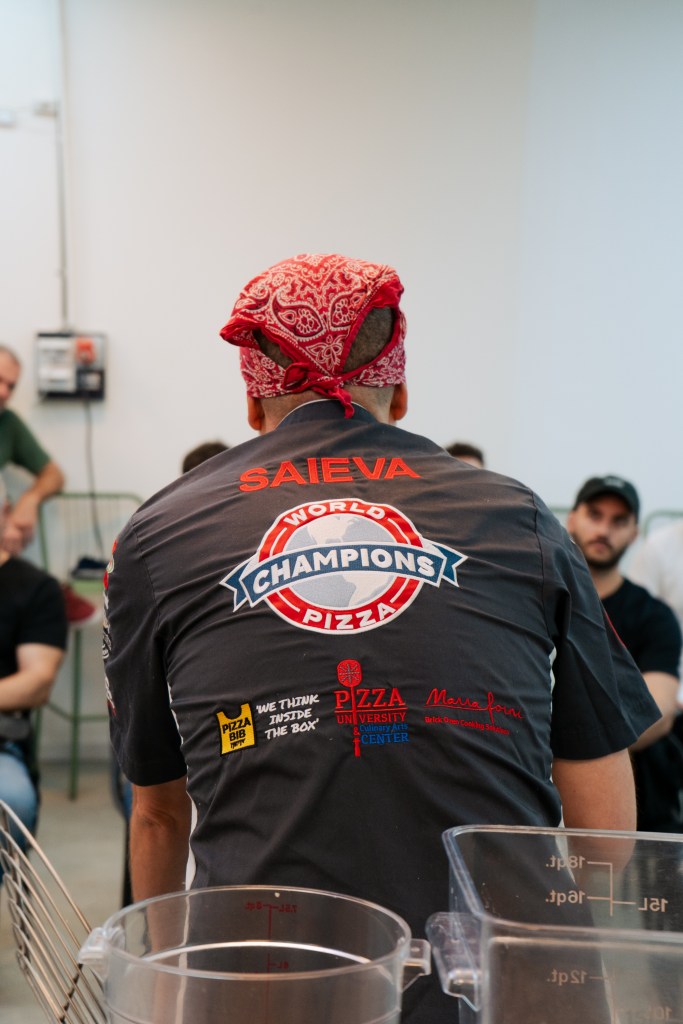
Learn directly from Massimiliano Saieva and develop the knowledge to understand your dough, improve your consistency and build Roman pizza with confidence.
Ready to go beyond the recipe?