

What is Roman Pizza? It’s one of Italy’s most iconic pizza styles, known for its crispy crust, airy crumb, and remarkable versatility. While Italian cuisine is famous around the world…
While many people immediately think of Naples, Roman pizza has become one of the country’s most respected pizza styles thanks to its light texture, crispy crust, and incredible versatility.
Unlike many online articles that simply describe Roman pizza, this guide explains what makes it unique, why it developed differently from other regional pizzas, and why professional pizzaioli consider it one of the most technically demanding styles to master.
Whether you’re a home baker, pizza enthusiast, or professional, understanding Roman pizza starts with understanding its principles—not simply following a recipe.
Roman pizza is not a single recipe or a single shape. It is a family of pizza styles from Rome and the Lazio region, traditionally recognized for their light structure, crisp exterior, and distinctive approach to dough, fermentation, and baking.
Unlike pizza styles that are defined primarily by a specific shape, Roman pizza is better understood through its texture and production methods. The dough is developed to create a light, open structure while maintaining enough strength to support the toppings and deliver a crisp, satisfying bite.
This combination of structure, crispness, and versatility is what makes Roman pizza unique.
Roman pizza is defined by its light structure, crisp exterior, and open crumb rather than by a single shape or presentation.
What Is Roman Pizza?

Roman pizza is a family of pizza styles that originated in Rome and the surrounding Lazio region.
Instead of focusing on one specific shape or presentation, Roman pizza is defined by several key characteristics:
- A light structure
- A crispy exterior
- An airy internal crumb
- Long fermentation
- High-quality ingredients
- Careful baking
Different Roman styles share these characteristics while offering different eating experiences.
The Main Styles of Roman Pizza
Roman pizza can take several different forms, but two of the most recognizable styles are Pizza in Teglia alla Romana and Pizza al Taglio.
Pizza in Teglia alla Romana is baked in a rectangular pan and is known for its highly hydrated dough, open crumb, crisp bottom, and light, airy texture. It became particularly popular in Rome during the 1980s and 1990s and developed into one of the defining expressions of modern Roman pizza.
Pizza al Taglio, meaning “pizza by the cut,” is traditionally displayed in rectangular pieces and sold by weight or portion. The customer chooses the amount they want, and the pizza is cut to order.
Although these styles can look different, they share an important philosophy: the dough is designed to create a balance between a light internal structure, a crisp exterior, and enough strength to carry the toppings.
Roman pizza can be prepared in different formats, but the underlying principles of dough development remain consistent.
What Makes Roman Pizza Different?
One of the defining characteristics of Roman pizza is the relationship between hydration, fermentation, dough development, and baking.
In particular, traditional Roman-style pan pizza uses a very high level of hydration. The ASR PizzaLab method describes hydration for Roman-style pan pizza within a range of approximately 75% to 100%, with 80% presented as an optimal reference point.
This high hydration contributes to the distinctive texture of the finished pizza: a light and open crumb combined with a dry, crisp bottom and a delicate crust.
But hydration alone does not create Roman pizza. Flour characteristics, fermentation time, dough temperature, mixing, handling, and baking all work together to determine the final result.
This is why simply increasing the amount of water in a dough does not automatically produce better Roman pizza. The dough needs to be developed and handled correctly so that it can support that level of hydration.
Roman pizza requires careful control of hydration, fermentation, dough development, and baking to achieve its characteristic texture.

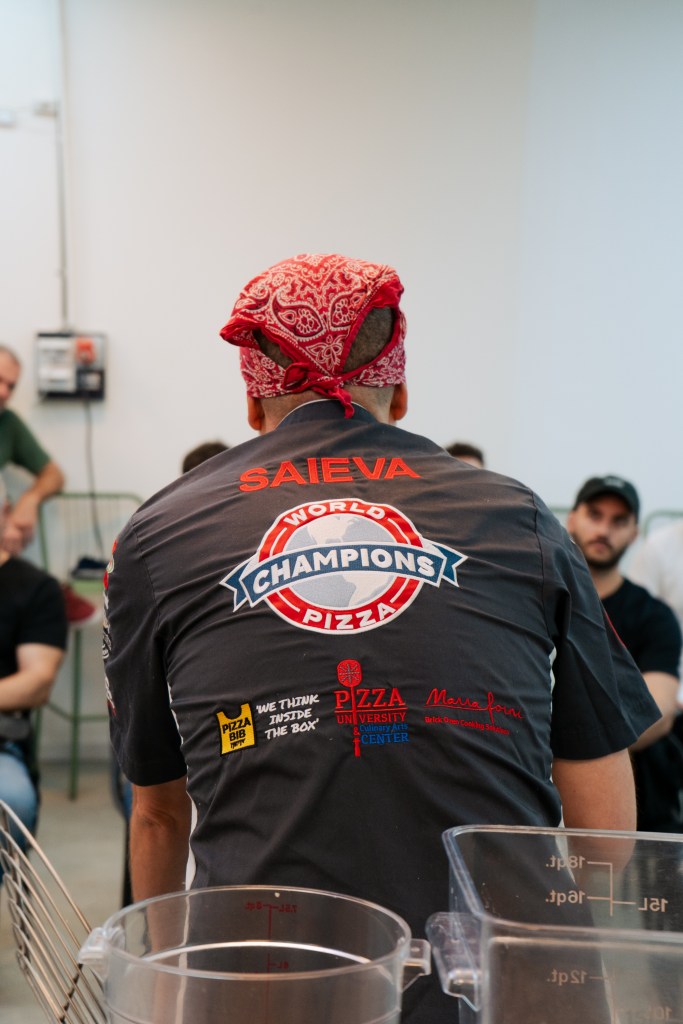
From World Pizza Champion Massimiliano Saieva
Many people believe Roman pizza is simply a crispy pizza. In reality, crispiness is only the final result of dozens of technical decisions made throughout the entire process. Understanding those principles is what separates a good pizza from a truly professional Roman pizza.
Roman Pizza vs. Neapolitan Pizza: What Is the Difference?
Roman and Neapolitan pizza are both Italian traditions, but they are built around very different approaches to dough, shape, texture, and baking.
Roman pizza is generally associated with a lighter, crispier structure and, particularly in the pan style, a highly hydrated dough with an open crumb. It can be rectangular, served by the slice, and adapted to a wide variety of toppings.
Neapolitan pizza, on the other hand, is traditionally round and designed around a soft, tender center with a characteristic raised cornicione. The dough, shaping process, baking environment, and final texture are fundamentally different.
The difference is therefore not simply about toppings or appearance. The two styles represent different approaches to dough development, fermentation, shaping, and baking.
Neither style is “better.” They are different pizza traditions, with different techniques and different eating experiences.
| Roman Pizza | Neapolitan Pizza | |
|---|---|---|
| Typical shape | Rectangular or round, depending on style | Round |
| Texture | Crisp exterior, light and open crumb | Soft center with raised cornicione |
| Pan style | Common in Pizza in Teglia | Not traditionally pan-baked |
| Hydration | Often high, especially in Pizza in Teglia | Different dough structure and hydration approach |
| Serving style | Can be sold by the slice | Usually served as an individual pizza |
| Baking approach | Depends on the Roman style | Very high-temperature, fast bake |

Why Is Roman Pizza So Crisp and Light?
The characteristic crispness of Roman pizza comes from several variables working together rather than from a single ingredient.
Dough hydration, flour characteristics, fermentation, dough temperature, mixing, handling, pan preparation, and baking all influence the final texture.
In Roman-style pan pizza, the high hydration of the dough plays an important role in creating the soft, open crumb, while the baking process develops the dry and crisp bottom that contrasts with the airy interior.
This balance is one of the reasons Roman pizza can feel both light and substantial at the same time.
Want to Learn How to Make Roman Pizza?
Understanding what Roman pizza is is only the beginning. Mastering it requires understanding how flour, hydration, fermentation, temperature, mixing, shaping, and baking work together.
At Roman PizzaLab, the focus is not simply on following recipes. The goal is to understand the principles behind Roman pizza so you can reproduce the results consistently and develop the skills needed to work with professional dough.
If you want to go beyond the theory and learn the Roman PizzaLab Method®, you can explore our online training and learn directly from Massimiliano Saieva.

Frequently Asked Questions About Roman Pizza
What is Roman pizza?
Roman pizza is a family of pizza styles originating in Rome and the Lazio region, known for distinctive dough development, crispness, light structure, and versatility.
Is Roman pizza the same as pizza al taglio?
Not exactly. Pizza al taglio is one form of Roman pizza, while Roman pizza includes different styles and approaches, including Pizza in Teglia alla Romana.
Why is Roman pizza so crispy?
Its crispness comes from the interaction between dough hydration, flour, fermentation, handling, and baking rather than from one single ingredient or technique.
Is Roman pizza better than Neapolitan pizza?
Neither is objectively better. Roman and Neapolitan pizza use different techniques and produce very different textures and eating experiences.
What hydration is used for Roman pizza?
Traditional Roman-style pan pizza can use very high hydration. The ASR PizzaLab manual describes a range of approximately 75% to 100%, with 80% as an optimal reference point.