

Roman pizza hydration has become one of the most discussed topics in modern pizza making.
70%. 75%. 80%. Even higher.
Hydration percentages are often presented almost as a measure of quality: the more water a dough contains, the better the pizza must be.
But that is not how dough works.
More water does not automatically make better pizza.
High hydration can contribute to an exceptionally light, open and crisp structure — particularly in Roman-style pizza — but only when the dough has been properly developed to manage that amount of water.
At Roman PizzaLab, we approach hydration differently:
Hydration is not a number to chase. It is a variable that must work in balance with flour, gluten development, mixing, temperature and fermentation.
Understanding that relationship is far more important than simply choosing a hydration percentage.

What Is Pizza Dough Hydration?
Hydration describes the amount of water in a dough relative to the amount of flour.
For example:
1,000 g flour + 700 g water = 70% hydration
1,000 g flour + 800 g water = 80% hydration
The calculation is simple:
Hydration % = Water ÷ Flour × 100
But the percentage alone tells us very little about the quality of the final dough.
Two doughs can both contain 80% hydration and behave completely differently.
Why?
Because water is only one part of the system.
What Does Higher Hydration Do to Pizza Dough?
When properly managed, higher hydration can contribute to some of the characteristics associated with excellent Roman pizza:
- an open internal structure
- greater expansion during baking
- a light crumb
- a crisp exterior
- good extensibility
- pronounced alveolation
But adding water alone does not create those characteristics.
The dough needs enough structure to hold that water and retain the gases produced during fermentation.
This is where gluten becomes essential.
During dough development, gluten proteins create a network capable of stretching and retaining gas.
As hydration increases, maintaining that structure becomes progressively more challenging.
If the dough is unable to manage the amount of water it contains, it can become sticky, weak and difficult to handle.
So instead of asking:
How much water can I add?
A better question is:
How much water can this dough successfully manage?
That is a completely different way of thinking about hydration.

Why 80% Hydration Doesn’t Work With Every Flour
One of the most common mistakes in pizza making is copying a hydration percentage from another recipe without considering the flour.
An 80% hydration dough made with one flour can behave very differently from another dough made at exactly the same percentage.
Different flours have different characteristics, including strength and water absorption capacity.
This means there is no universal “perfect hydration” for pizza.
The correct hydration depends on the flour and the process being used.
If 75% hydration produces better structure, handling and baking performance than 85%, then 75% is the better dough.
There is no prize for making the wettest pizza dough.
The Overlooked Variable: Dough Temperature
Temperature is usually discussed in pizza making because of its effect on fermentation.
But temperature is also important during dough development itself.
Mixing generates friction, and friction generates heat.
As the dough’s temperature changes during mixing, its behavior can change as well.
This becomes particularly important with high-hydration dough, where maintaining the right balance between water and structure is essential.
Research into wheat dough has also shown that mixing temperature can influence gluten behavior, elasticity, water absorption and dough stability.
This is why, at Roman PizzaLab, temperature is not considered only a fermentation variable.
It is part of dough management.
And this distinction becomes increasingly important as hydration rises.
A Technique Developed Through Experimentation
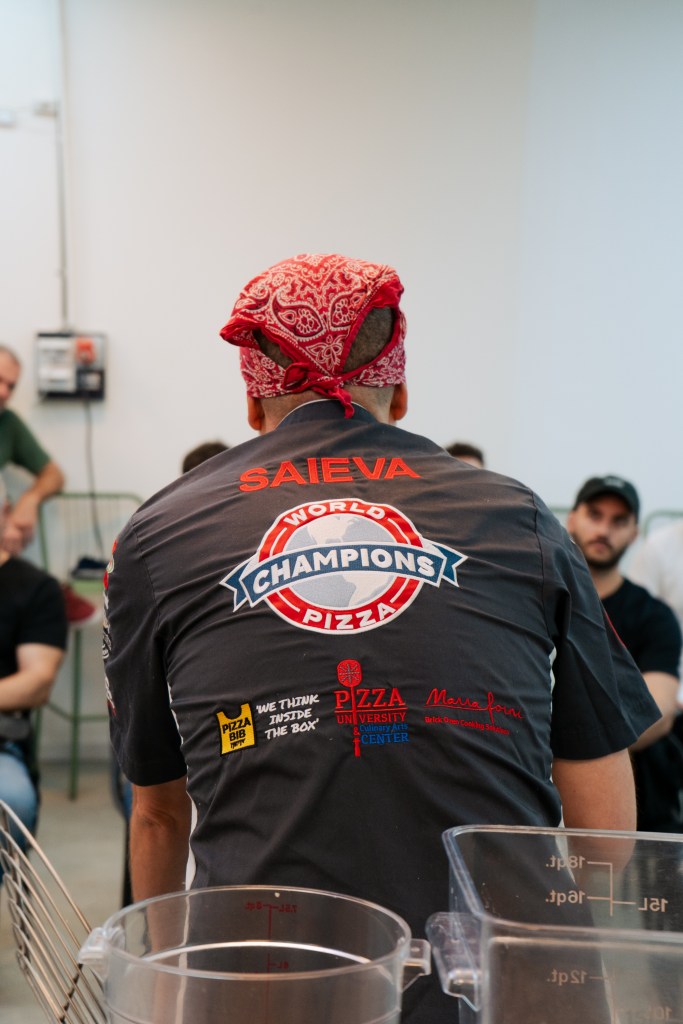
Long before studying the scientific explanations behind these phenomena, Massimiliano Saieva had already reached similar conclusions through years of practical experimentation.
Working with highly hydrated Roman pizza doughs, he repeatedly tested how changes in the dough-making process affected strength, elasticity, stability and the final baked structure.
His objective was never simply to reach the highest possible hydration.
The real challenge was:
How can we create a highly hydrated dough while maintaining control over its structure?
Through years of testing, Massimiliano developed his own approach to managing high-hydration dough.
Only later did he encounter scientific explanations supporting some of the principles he had observed empirically.
Those years of experimentation eventually became part of what is taught today through the Roman PizzaLab Method®.


High Hydration Is About Balance
This is perhaps the most important concept to understand.
A recipe might tell you to make an 80% hydration dough.
But the number alone cannot tell you whether that dough will succeed.
The final result depends on the interaction between several variables:
Flour + Water + Gluten Development + Mixing + Temperature + Fermentation
Change one variable and you can change the behavior of the entire dough.
This is why professional pizza making requires more than memorizing recipes.
It requires understanding relationships.
Why Is My High-Hydration Pizza Dough So Sticky?
Stickiness is one of the most common problems when people begin experimenting with high hydration.
The immediate reaction is often to add more flour.
But that changes the formula and reduces the effective hydration.
Excessive stickiness can have several causes.
The flour may not be suitable for the amount of water being used. The dough may not have developed enough structure. Temperature may not have been properly managed. Fermentation may also have progressed beyond what the dough can support.
The important lesson is that sticky dough is not automatically solved by adding flour.
First, you need to understand why the dough is behaving that way.


High Hydration Doesn’t Automatically Mean Better Pizza
High hydration has become fashionable.
But professional pizza making isn’t about impressive percentages.
It’s about the final result.
For Roman pizza, we are looking for a balance of:
lightness, alveolation, crispness, structure and consistency.
Sometimes that may require higher hydration.
Sometimes it may not.
The percentage is simply a tool.
And the best pizza maker is not necessarily the person using the most water.
It is the person who understands why the dough behaves the way it does.
Learn to Read the Dough, Not Just the Recipe
This is one of the biggest differences between following a recipe and truly understanding pizza making.
A recipe gives you numbers.
Experience teaches you how to interpret what is happening in front of you.
Instead of asking:
“The recipe says 80% hydration. Why isn’t this working?”
you begin asking:
“Can this flour and this dough actually manage 80% hydration?”
Instead of simply following a mixer timer, you learn to evaluate the development of the dough.
And instead of chasing percentages, you begin designing the dough around the result you want to achieve.
That is when pizza making stops being about following instructions and becomes a craft.


Final Thoughts
High hydration can produce extraordinary Roman pizza.
But water is not the secret. Control is.
Great high-hydration dough comes from understanding how flour, water, gluten development, mixing, temperature and fermentation interact.
Once you understand those relationships, hydration stops being an impressive percentage written in a recipe.
It becomes a tool for creating the texture you want.
That philosophy is central to the Roman PizzaLab Method®.
We don’t teach students simply to reproduce a formula. We teach them to understand the dough so they can control the result.
Continue learning:
Roman Pizza Dough: Hydration, Fermentation and the Science Behind the Crunch →
What Is Roman Pizza? The Complete Guide to Italy’s Crispiest Pizza →
Roman Pizza vs Neapolitan Pizza: What’s the Difference? →
Best Flour for Roman Pizza: What Professionals Look For